Sunday, May 15, 2016

Woman Ordnance Worker (WOW)

The Springfield Armory: Forge of Innovation
www.forgeofinnovation.org

The Armory was better prepared for war production in 1941 than it had been in 1917. At the time of the Japanese attack on Pearl Harbor, the production quota of M1s was 1,100 per day; by July 1943 it nearly doubled to 2,100 per day. At the same time the workforce increased from 7,500 to 12-13,000. As in World War I, women were hired to help overcome the labor shortage induced by the draft; they constituted 20% of the workers by June 1942 and 43% by June 1943. Despite this measure, the workforce declined in number to 11,300-11,800 in the second half of 1943, to 10,900 by June 1944, and to 9,400 by the end of 1944.

While some leaders only urged women to continue such traditional roles as knitting, buying bonds, stretching rationed foodstuffs and keeping up the nation's morale, others on the home front challenged women to join the ever-growing ranks of America's "production soldiers." In September 1942, Secretary of War Henry L. Stimson made public his plan to double the number of women hired in war jobs. Newspaper accounts of that time reported that since 1 June 1942 the number of skilled women workers in the War Department had risen from 3 percent to 10 percent. Almost 35 percent of the department's unskilled workers were women.

Uncertainty about the willingness and ability of American housewives to assume a larger defense role was expressed nationally as well as locally. One labor analyst warned that, "The employment of millions of untrained workers, including old men, youths, and housewives,...[would] inevitably result in a material and gradual dilution of labor skills, which...[meant] a decline in manpower output." The previously successful employment of women defense workers, according to this same analyst, was "...attributable to the fact that the more experienced and best adapted have naturally been the first employed. As...[the nation drew] more and more upon inexperienced and untrained homemakers, the average efficiency of women...[would] decline."

During World War II some three million women worked in war plants across the United States. Working women were vital to the war effort, as the loss of men to military service left a workforce shortage in many areas. The U.S. Government undertook a major public relations campaign to encourage women to work. The use of an invented character, Rosie the Riveter, on a brightly colored poster was a powerful propaganda piece.

Woman Operating
Chambering Machine
Most of the women employed by the Army had to adjust not only to working outside the home but had to accustom themselves to working under conditions that would have tried the stamina and patience of experienced male industrial workers. In addition, many of the women workers at both arsenals contributed what little spare time they had to supporting a variety of home front activities such as Red Cross work, war bond drives, and packaging special seasonal boxes for distribution to soldiers overseas.

The pressures of work, the strain of trying to keep up with family obligations, the stress of worrying about loved ones fighting in the war or being held prisoner behind enemy lines, the lack of adequate rest and nutrition, even ill health all contributed to higher levels of absenteeism among women workers. To keep up the morale of all their workers, Army officials sponsored special after-hours social events such as dances. Another was the September 29th, 1943, big band concert by Benny Goodman and his Spotlight Band given to the employees on the grounds near the Main Arsenal (housing the present-day Museum of Springfield Armory National Historic Site). Special awards ceremonies were held so that employees could be a part of the recognition given to the production successes enjoyed by all workers.

WOWs to the Rescue!

Throughout Springfield Armory's history, women played an important role. Women worked in many different departments, including machine operators, inspectors, and assemblers. In World War I, 15% of the workers were women. At the height of World War II, over 5,000 Women Ordnance Workers (WOW) comprised 42% of the Armory's workforce.

The WOW concept was created to foster patriotic spirit and identification with the war effort by women working in the U.S. Army's war production sites. WOWs wore a red bandana with distinctive markings of a flaming bomb ... not only for safety reasons but from a sense of pride, accomplishment and achievement in their contributions to the war effort. When those bandanas were paired with blue all-purpose coveralls, those WOWs were nothing if not patriotic!

Inspiration for Iconic Rosie the Riveter Image Dies

ROSIE THE RIVETER SONG

Women's Land Army (WLA)

The Women's Land Army
found at www.britannica.com

The Women’s Land Army (WLA) was a U.S. federally established organization that from 1943 to 1947 recruited and trained women to work on farms left untended owing to the labor drain that arose during World War II.

By the summer of 1942, American farmers faced a severe labor shortage—since 1940 some six million farm laborers had left the fields for higher-paying wartime factory jobs or for service in the armed forces. Radio stations and newspapers made urgent pleas for volunteers to help with the harvest. 

Women with little or no agricultural experience answered the call and, on an informal basis, saved countless crops from rotting in the fields. It soon became clear, however, that the situation required a more organized approach if the nation was to mobilize a reliable force of farm workers. By 1943 the U.S. Congress had allocated funds for the Emergency Farm Labor Service, which included the recruitment, training and placement of a female corps of farm laborers to be known as the Women’s Land Army, a subdivision of the United States Crop Corps. Recruits were not expected to have farming experience, but the WLA specified that applicants be physically fit and possess manual dexterity, patience, curiosity and patriotism.

The WLA recruited more than a million female workers, drawn from the ranks of high school and college students, beauticians, accountants, bank tellers, teachers, musicians and many other occupations. The women worked long hours driving tractors, tending crops, and even shearing sheep. Most laborers received an unskilled worker’s wage—25 to 40 cents per hour—out of which they were to pay for their denim overall uniforms and their meals and lodging in temporary camps, summer cabins and private homes. 

Most workers did not join the WLA to make money but wanted to contribute to the war effort. By the end of 1944, the WLA had more than proved itself as an indispensable brigade of hard workers, and farmers were eager to enlist their services in the upcoming season. Women continued to volunteer their services in the immediate postwar period.

Friday, April 15, 2016

The "Hello" Girls of WWI

History of the Signal Corp Female Telephone Operators Unit

Although the term 'Hello Girls' was used by the Signal Corps, it did not originate there. It had been the common name used for switchboard operators who would say "hello" when you rang the switch as opposed to calling direct.The earliest reference to Hello Girls is in Mark Twain's A Connecticut Yankee in King Arthur's Court written in 1889. 

The history of the Signal Corp "Hello Girls" begins in late 1917 when General Pershing made his emergency appeal for bilingual telephone switchboard operators. Published in newspapers throughout the United States, it specifically sought French-speaking American women who held the position of switchboard operator in the new Bell Telephone Company.

Pershing wanted women because, as he stated, they have the patience and perseverance to do long, arduous detailed work. He had found that men in the Signal Corps had difficulty operating the switchboards for these reasons. He also wanted men to be in the field stringing wire necessary for communication from the trenches to the A.E.F. GHQ at Chaumont. It was the first time in the history of warfare that soldiers in the front-lines were connected to the General command.

Over 7,000 American women applied. There were few, however, among the 700 volunteers throughout Bell Telephone, who spoke French. In selecting the first 300, the age requirement and even the switchboard training was waived. Married women were accepted if not married to anyone serving overseas.

After being sworn into the U.S. Army, they began their Signal Corps training at Camp Franklin, now a part of Fort George G. Meade in Maryland. They were given the same status as nurses and were subject to all Army regulations, including Court-Martial, with ten extra regulations placed on them to assure their moral character. They had the rank of lieutenant and had to buy their own uniforms.


The first operators left for Europe in March 1918, under the lead of Chief Operator Grace Banker. Members of this unit were soon operating telephones in many exchanges of the American Expeditionary Forces in Paris, Chaumont and seventy-five other French locations as well as British locations in London, Southampton and Winchester.

Because they were considered civilians employees of the military, they were not given honorable discharges because Army regulations specified the male gender. In 1978, the 60th anniversary of the end of World War I, Congress approved Veteran Status/Honorable discharges for the remaining Signal Corp Hello Girls. For the seventy women still alive, there was nation-wide coverage in the newspaper. Each was visited by a General of the U.S. Army and handed her Honorable Discharge in a ceremony at her home.

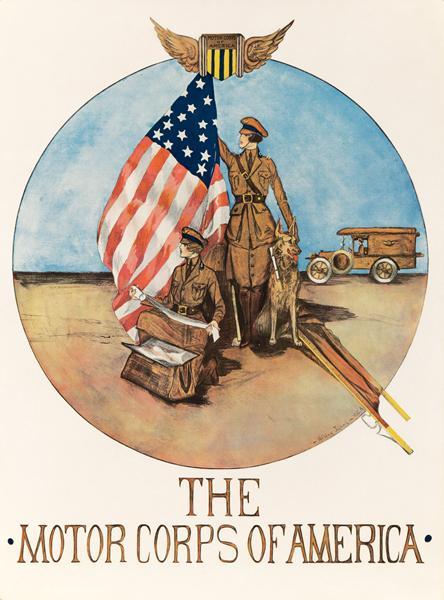
WWI Motor Corp of America

History of the Motor Corp of America


In response to World War I women began to take on new responsibilities in the war effort. The MotorCorps of America provided the opportunity for women to learn to drive and maintain vehicles. Here we see buttons and signage from a New York City Motor Corps volunteer named Dorothea Harnecker, donated to the City Museum by her daughter Mrs. Beatrice Stone.

The Motor Corps of America was a volunteer effort established by the National League of Women’s Services and the Red Cross. The organization provided transportation and ambulatory services to military personnel. The Motor Corps was one of the most demanding divisions of the league and required a chauffeur’s license, mechanic’s license, and many hours of training.

Continue reading at the Museum of the City of New York site by clicking HERE.


The "Marinettes" of WWI

History of the Marinettes

Faced with manpower shortages in 1918, Major General Commandant George Barnett asked the Secretary of the Navy's permission to enlist women for clerical duties during World War I. The first woman to enroll in the Marines was Opha Mae Johnson on 13 August 1918. 305 more women joined, serving only in the United States. At the end of the war, they left the Marine Corps to return to domestic life.

Marine Corp Reservist (F) was the only official title by which the Corps first enlisted women were known, however, throughout the duration of their service many nicknames were coined to identify them. On the occasion of their first official visit to Quantico on 21 November 1918, Corporal Elizabeth Shoemaker heard the title 'Lady Hell Cats' used for the first time when an enthusiastic marine shouted it from the crowd as they marched by.

During a party planned for the women that same evening, Corporal Shoemaker recalled overhearing one disgruntled young Marine telling his buddies: "This is a fallen outfit when they start enlisting skirts," hence 'Skirt Marines' was added to the growing list. But the most popular and most widely used of all the nicknames was 'Marinette'. 

"The United States Marine Corps frowned upon the use of the word 'Marinette'," remembered Corporal Avadney Hea, "they posted notices every once in a while on the bulletin board, that we were not to be referred to as 'Marinettes'. We were United States Marine Corps reservists with (F) after it, indicating female. We were not to be called 'Marinettes'. The Marine Corps didn't like it."

In spite of that fact, however, many people still refer to the Marine Reserves (F) as Marinettes.
Marine Reservists (F) pose for a photograph at Headquarters,
Marine Corp, Washington, DC in 1918.
(Photo: Marine Reserve/Marine Corps Archives)
Click HERE to read Women Marines in World War I.
Click HERE to read about Opha Mae Johnson.